• Hey Guest,

    We wanted to share a quick update with the community.

    Our public expense ledger is now live, allowing anyone to see how donations are used to support the ongoing operation of the site.

    👉 View the ledger here

    Over the past year, increased regulatory pressure in multiple regions like UK OFCOM and Australia's eSafety has led to higher operational costs, including infrastructure, security, and the need to work with more specialized service providers to keep the site online and stable.

    If you value the community and would like to help support its continued operation, donations are greatly appreciated. If you wish to donate via Bank Transfer or other options, please open a ticket.

    Donate via cryptocurrency:

    Bitcoin (BTC):
    Ethereum (ETH):
    Monero (XMR):
D

Dena

Member
Oct 7, 2024
8
In the farthest chamber of the mind lives an ancient sovereign—
formless, faceless, yet absolute.

It speaks without voice, commands without gesture,
a quiet deity of ruin whispering through the corridors of thought.

Its presence bends every choice, like iron softened in the forge of fate.

It rises as storm,
descends as tide,
and washes the self clean of memory, will, and name.

This is the art of self-destruction.

Not an impulse—
but a ritual.
Not an accident—
but a pilgrimage.

A path laid long before your first breath, carved in the marrow of your being.

At times you glimpse a different life, a life woven from gentler threads—
but the vision shatters like glass dropped upon stone, and you awaken once more inside the labyrinth built from your own shadow.

And then comes the questioning, the ancient litany:

Why this road of ruin?
Why this unweaving of all that once resembled good?

The answer is not modern;
it is older than scripture, older than language:

Some souls are born
not to create,
but to unravel.

The descent begins subtly—
a hesitation,
a fracture—
until the self is slowly disassembled, bone by bone, belief by belief,

as though returning materials to the cosmic dust from which they came.

This, too, is art.

You withdraw from the tribe.
You let the ties that bind you fall away,
one thread at a time.
Solitude becomes a cloak—
heavy, familiar, indestructible.

People avert their eyes, not out of cruelty, but because your presence reflects the secret they fear:
that order is fragile,
that meaning is borrowed,
that existence can dissolve without warning.

Most humans crave monuments.
You crave erasure.
They fight to leave a footprint;
you walk where the sand devours every trace.

And so you ask:
What remains of me?

Nothing.
And in that nothingness,
a strange, austere peace.

You stepped away from the choreography of the living long ago.
Now each day is merely another echo in the machinery of existence,
another turn in the great, indifferent wheel.

It is not oblivion you long for—
but the stillness beyond suffering.
These are not the same.

Your wounds are mostly self-fashioned, forged in the workshop between nature and nurture.

Perhaps your curse is lucidity—
the ability to peel apart every emotion,
to examine memory the way a priest reads omens from the entrails of sacrificed beasts.

Some call this rumination.
You call it survival.
But what is it you are trying to save?

Ahead lies the final bend—
a threshold crossed only once, a path leading to the great Silent Realm,
where thought ends,
and pain collapses into dust.

For years you have walked the precipice of this world,
hoping the earth might shift and release you into deeper mysteries.

The shadow above grows denser,
as though the heavens themselves lean down to witness your vigil.

You wonder:
What compels people to cling to life?
What ancient impulse makes them grasp, gasp, fight?

Perhaps the truth is simple:
you have never lived—
only dreamed of living.
You have wandered through palaces of fantasy, inhabiting them as a ghost occupies the ruins of a forgotten temple.

But every dream ends the same:
with the solitary figure left among the broken pillars.

Better to choose solitude
than be cast into it by fate.

But let us tear away the last veil.

These are not doctrines—
but shelters built of shadow.
Numbness is safer than joy,
silence safer than hope.

For what we call happiness is merely the brain's small trick,
a fleeting alchemy of borrowed chemicals,
a fragile spark in the dark machinery of flesh.

And you are not a worshipper of sparks.

So you do the final, sovereign act:
you burn the world you once built,
before any other hand can claim the fire.

You are the architect of your own realm— even if that realm is barren, echoing, haunted by winds that speak in forgotten tongues.

But it is yours.
Only yours.

And in the language of all mortal endings:

Ashes to ashes.
Dust to dust.
 
Last edited:
  • Love
  • Like
  • Hugs
Reactions: SurrealCereal, Mio_Kamimachi, Forever Sleep and 8 others
C

continuing

Member
Aug 8, 2024
55
damn, are you the one who made this ?, cause if you did thats beatiful.
I may geeting all wrong, if i do sorry, but i guess you really showed what the feeling of wanting to end feels.

At least for me is a lot about, wanting to end everything them trying to live for a gimpse of hope, cause of my fear of future failure.

Some stuff that are myself is that i do belive that for me is a choice, that i might have a chance but im choosing to ending, but even that, if i am choosing to end, did i ever had a chance to begin with ?
 
  • Like
Reactions: SurrealCereal and Dena
sheeplit

sheeplit

Member
Mar 8, 2023
47
A beautiful reminder of how poorly I write. Where is this from? If it is your writing, I'd love to read more.
 
  • Hugs
Reactions: SurrealCereal and Mio_Kamimachi
D

Dena

Member
Oct 7, 2024
8
Yes, it's something I wrote.

It's a reflection on non-somatic pain - the kind that isn't physical, but still feels unbearable - and on the loss of perspective that can happen when life starts to feel closed off.
At 40, I've come to a place where simply surviving no longer feels like an answer. The painful truth is that I did want to live. I wanted life to feel possible. But when you become your own worst enemy, it is exhausting to keep fighting yourself every day.
damn, are you the one who made this ?, cause if you did thats beatiful.
I may geeting all wrong, if i do sorry, but i guess you really showed what the feeling of wanting to end feels.

At least for me is a lot about, wanting to end everything them trying to live for a gimpse of hope, cause of my fear of future failure.

Some stuff that are myself is that i do belive that for me is a choice, that i might have a chance but im choosing to ending, but even that, if i am choosing to end, did i ever had a chance to begin with ?

day.
 
  • Love
  • Hugs
Reactions: SurrealCereal, Mio_Kamimachi and Forever Sleep
F

Forever Sleep

Earned it we have...
May 4, 2022
15,440
This is so sadly beautiful. I imagine it resonates with so many people here. Amazingly well written too. Thank you for sharing it.
 
  • Like
  • Love
Reactions: SurrealCereal, Dena and Mio_Kamimachi
SurrealCereal

SurrealCereal

NYAAAA!
May 10, 2026
13
This feels less like a poem and more like a ritual. The imagery of the labyrinth built from your own shadow is so vivid. So unique. It's rare to see self-destruction written about with such dignity and lucidity. Truly well done. You have my respect and admiration!
 
webb&flow

webb&flow

dum spiro spero—take it as it comes
Nov 30, 2024
664
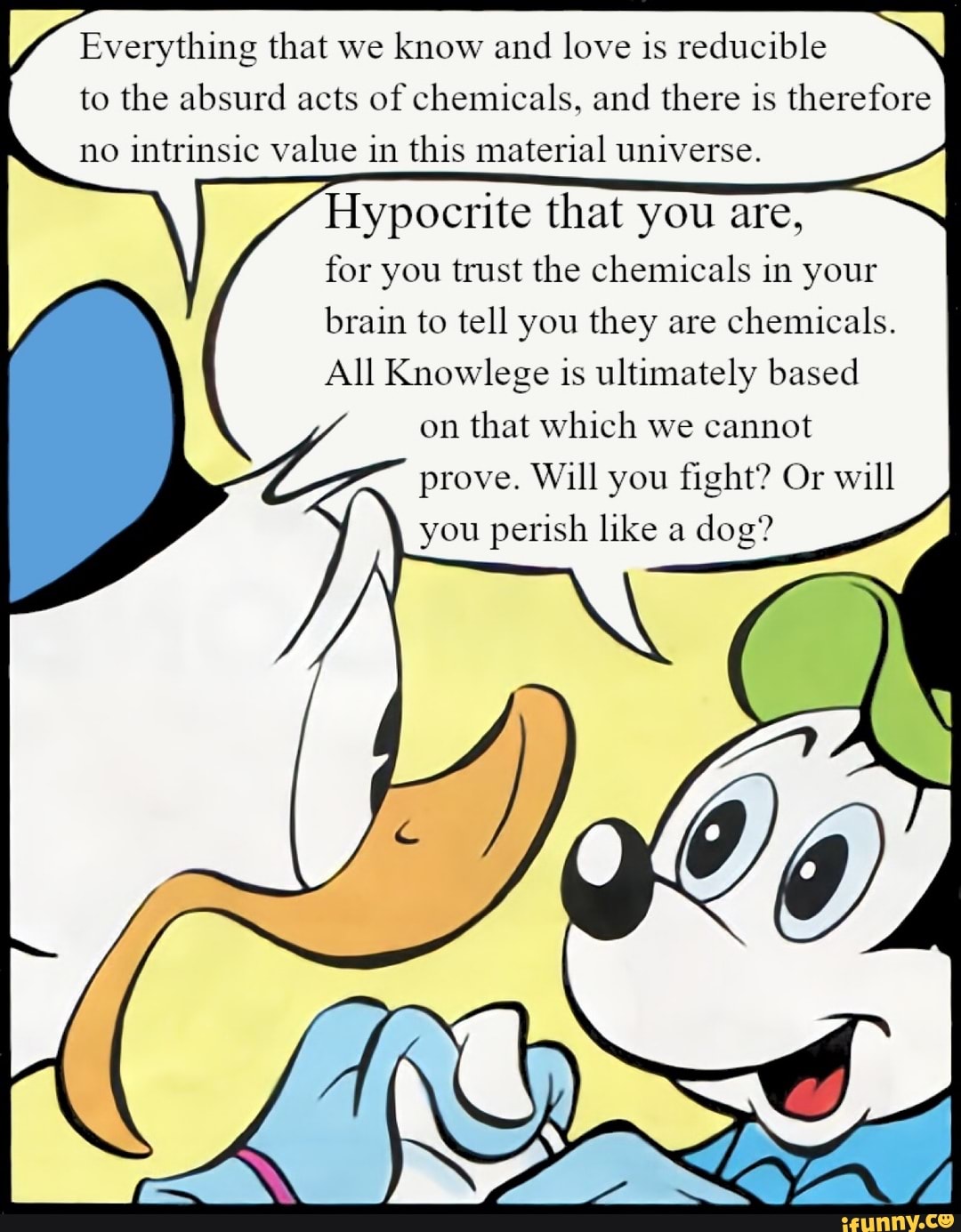
For what we call happiness is merely the brain's small trick,
a fleeting alchemy of borrowed chemicals,
a fragile spark in the dark machinery of flesh.
b56f0c49f29de6f14edd0310e6d1c600ea054a4bcb58ee9c27ace99957fda2aa_1.jpg
If you believe all emotions are chemicals, why are chemicals "worthless"? Let's say we are speaking in person, and you said "Emotions are chemicals, and chemicals are meaningless, therefore emotions are meaningless." And then, a random passerby comes in and punches me in the stomach. "OW!", I cry out. "That's just chemicals in your brain," you might continue, "you shouldn't care about that. Just meaningless chemicals. No meaning. No value. All ju-" "Could you help me get up‽‽".

You see—just because something can be explained in scientific terms, doesn't mean it's empty. Explaining the different spectrums of shades in the rainbow, does not in the least destroy the actual colours experienced in the human eye. Just because you explain something, doesn't make it meaningless. Some people say science explaining things ruins the "wonder" of the nature of things. But there is beauty in understanding, too.

And you are not a worshipper of sparks.
In the words of David Foster Wallace: Everyone worships. What do you worship?

Numbness is safer than joy,
silence safer than hope.
That kind of safety is not a safe peace but a safe pain.
They who can give up essential liberty to obtain a little temporary safety, deserve neither liberty nor safety.

Benjamin Franklin
And whoever sacrifices liberty for safety, will usually squander both, unnecessarily.

But let me quote a poet to a poet, now.
The stag, superior in fight, drove the horse from the common pasture, till the latter, worsted in the long contest, implored the aid of man and received the bridle; but after he had parted an exulting conqueror from his enemy, he could not shake the rider from his back, nor the bit from his mouth. So he who, afraid of poverty, forfeits his liberty, more valuable than mines, avaricious wretch, shall carry a master, and shall eternally be a slave, for not knowing how to use a little.

—Horace. Epistles 10:1.
When we allow ourselves to be utterly dominated by despair, we are not actually freeing ourselves from the worship of desirable things, but merely consigning ourselves into the worship of emptiness itself. We are not freeing ourselves, but merely exchanging our citizenship, And so no one who claims to revere emptiness and death and suicide, can truly say that they have freed themselves of worship and reverence and devotion. Yes, they can say "I no longer revere Life! I no longer worship Life!". But the truth is, they do still have values: just different ones.

Perhaps the truth is simple:
you have never lived—
only dreamed of living.
You have wandered through palaces of fantasy, inhabiting them as a ghost occupies the ruins of a forgotten temple.
A poet should know that truth and life is anything but simple. The aim of poetry should not be to narrow and choke the entirety of lifeblood into a single point, but to cut open what has been languished, to open up the flow and the eyes, to open up the world. It is no secret that practically all poetry is a fantasy of some sort. But because all of them are imaginations, are fantasy, this means that they are all practically on the same footing. So this means the one who dreams of depths is no truer than one who dreams of heights.

What does it mean to "live"? To live that life you say that "I" have never lived? I ask you this genuinely.

And is not dreaming a kind of life, anyway? What is wrong with a dream? Einstein said "Imagination encircles the world". What is wrong with using dreams to add colour to life?

One who creates great wonders inside the mind and explores them, would you say this person is dead at all? And how can a temple be forgotten if someone is wandering through it‽‽ That's the exact opposite of being forgotten, that is the definition of being discovered and cherished. And I do not register ghosts, no, I do not believe the living are ghosts at all, if ghosts even exist.

For some amicability between us, you may be interested in what Kafka wrote on this matter, on "he fears death because he has not yet lived".

So you do the final, sovereign act:
you burn the world you once built,
before any other hand can claim the fire.

You are the architect of your own realm— even if that realm is barren, echoing, haunted by winds that speak in forgotten tongues.
You say this realm is "barren", yet mention it as being built, having something in it. Which one is it?

A path laid long before your first breath, carved in the marrow of your being
So a path exists inside of you before you exist. How can you claim inexistence completely obliterates if you believe there are things that are somehow part of your being before you even exist?

Not an impulse—
but a ritual.
Not an accident—
but a pilgrimage.
Rituals are arbitrary and can be made out of anything. A ritual, just like poetry itself, can be used to revere anything. They can be used to revere life, revere death, to reject life, to reject death; language can say anything, poetry can revere anything, ritual can revere anything. This does not make a ritual authoritative.

In the farthest chamber of the mind lives an ancient sovereign—
formless, faceless, yet absolute.

It speaks without voice, commands without gesture,
a quiet deity of ruin whispering through the corridors of thought.

Its presence bends every choice, like iron softened in the forge of fate.
These are many finely written words, but the idea in them all remains the same. "Submit to the impulse to die. You have no power against it." The truth is that fate is a myth, just as many myths have been constructed by humanity. The word fate is even etymologically related to the word fable, to look to the language.

And you speak of this mind having chambers and sovereigns and deities, that influence us constantly. How is this not a "palace of fantasy"? This image is no more objective or "truthful" than the examples you criticize.
It rises as storm,
descends as tide,
and washes the self clean of memory, will, and name.

This is the art of self-destruction.
It does not wash anything clean, but merely injures further.

Anything can be art. This does not mean it is any more righteous than any other thing.
 
P

PanaxMan

Water fasting until death (Currently homeless)
Apr 11, 2023
641
In the farthest chamber of the mind lives an ancient sovereign—
formless, faceless, yet absolute.

It speaks without voice, commands without gesture,
a quiet deity of ruin whispering through the corridors of thought.

Its presence bends every choice, like iron softened in the forge of fate.

It rises as storm,
descends as tide,
and washes the self clean of memory, will, and name.

This is the art of self-destruction.

Not an impulse—
but a ritual.
Not an accident—
but a pilgrimage.

A path laid long before your first breath, carved in the marrow of your being.

At times you glimpse a different life, a life woven from gentler threads—
but the vision shatters like glass dropped upon stone, and you awaken once more inside the labyrinth built from your own shadow.

And then comes the questioning, the ancient litany:

Why this road of ruin?
Why this unweaving of all that once resembled good?

The answer is not modern;
it is older than scripture, older than language:

Some souls are born
not to create,
but to unravel.

The descent begins subtly—
a hesitation,
a fracture—
until the self is slowly disassembled, bone by bone, belief by belief,

as though returning materials to the cosmic dust from which they came.

This, too, is art.

You withdraw from the tribe.
You let the ties that bind you fall away,
one thread at a time.
Solitude becomes a cloak—
heavy, familiar, indestructible.

People avert their eyes, not out of cruelty, but because your presence reflects the secret they fear:
that order is fragile,
that meaning is borrowed,
that existence can dissolve without warning.

Most humans crave monuments.
You crave erasure.
They fight to leave a footprint;
you walk where the sand devours every trace.

And so you ask:
What remains of me?

Nothing.
And in that nothingness,
a strange, austere peace.

You stepped away from the choreography of the living long ago.
Now each day is merely another echo in the machinery of existence,
another turn in the great, indifferent wheel.

It is not oblivion you long for—
but the stillness beyond suffering.
These are not the same.

Your wounds are mostly self-fashioned, forged in the workshop between nature and nurture.

Perhaps your curse is lucidity—
the ability to peel apart every emotion,
to examine memory the way a priest reads omens from the entrails of sacrificed beasts.

Some call this rumination.
You call it survival.
But what is it you are trying to save?

Ahead lies the final bend—
a threshold crossed only once, a path leading to the great Silent Realm,
where thought ends,
and pain collapses into dust.

For years you have walked the precipice of this world,
hoping the earth might shift and release you into deeper mysteries.

The shadow above grows denser,
as though the heavens themselves lean down to witness your vigil.

You wonder:
What compels people to cling to life?
What ancient impulse makes them grasp, gasp, fight?

Perhaps the truth is simple:
you have never lived—
only dreamed of living.
You have wandered through palaces of fantasy, inhabiting them as a ghost occupies the ruins of a forgotten temple.

But every dream ends the same:
with the solitary figure left among the broken pillars.

Better to choose solitude
than be cast into it by fate.

But let us tear away the last veil.

These are not doctrines—
but shelters built of shadow.
Numbness is safer than joy,
silence safer than hope.

For what we call happiness is merely the brain's small trick,
a fleeting alchemy of borrowed chemicals,
a fragile spark in the dark machinery of flesh.

And you are not a worshipper of sparks.

So you do the final, sovereign act:
you burn the world you once built,
before any other hand can claim the fire.

You are the architect of your own realm— even if that realm is barren, echoing, haunted by winds that speak in forgotten tongues.

But it is yours.
Only yours.

And in the language of all mortal endings:

Ashes to ashes.
Dust to dust.
Peak explanation for the end of the star that feeds us the sun
 

Similar threads

Yuja
Replies
6
Views
135
Offtopic
Yuja
Yuja
KuriGohan&Kamehameha
Replies
6
Views
343
Suicide Discussion
Raindancer
Raindancer
I
Replies
10
Views
781
Suicide Discussion
ben_
ben_